
Did That Cashback Site Really Drive This Sale?
Are cashback, voucher and incentive websites making you pay twice for a sale that would have happened without them anyway?
So cashback sites are stealing your sales?
Well... not really.
Well... actually maybe sometimes.
But mostly, no, they're not.
Anecdotally, I've seen both sides of the story.
With a sales journey progressing over multiple days, browsing review sites, YouTube walkthroughs and clicking through every image in the product gallery, I was 2 minutes away from completing checkout before a last ditch attempt to find a discount voucher code led me to a cashback site (one of the 'top' ones 👀) that I went through before getting the purchase over the line.
Somewhere, there's someone in sales and marketing pulling their hair out because their target CPA was met via the organic and paid activity to get me into the checkout, and they've had to pay out again in commission to the affiliate site that got involved mere moments before I would've opened my wallet anyway.
On the other side of the coin, I have browsed incentive sites with no real purchase in mind and locked eyes with a product that was borderline irresistible due to the cashback on offer, and £30 later I'm the proud owner of a men's skincare and facial grooming box set that I never would have thought about otherwise, let alone bought. (I'm a repeat customer now with a recurring subscription)
Equally, the sales and marketing team are now patting themselves on the back at a job well done.
So what is actually happening?
Realistically, incentive sites are doing a couple of things for your brand: They are creating NEW demand for your product, or they are converting EXISTING demand for your product.
When these sites create new demand, they are putting their marketing efforts towards finding and attracting new users, getting them through the funnel and onto your site, generating sales. As far as the brand is concerned, apart from maintaining and optimising the partner relationship, they haven't really had to work for that sale as it has essentially just fallen into their lap and a small commission payment in return is great value.
Much like the more organic content sites, review sites, comparison websites, etc... having a sale 'appear' in this way is the dream for all brands and can be considered the perfect affiliate channel win!
The 'problem' that brands are facing - or think they are facing - is that if the incentive site has NOT generated the demand themselves, they feel all their hard work and budget is counting for nothing as these sites swoop in at the final hour to take ownership of a sale that was going to happen anyway without them. But is this a true reflection of what incentive sites are doing to your brand?
The benefits of incentive-based affiliate partners.
Before we get into some of the lesser-known benefits, we can challenge the assumption that a last-minute incentive site touchpoint is 'stolen' sales attribution at all.
- A study by Rakuten showed that adding a 'cashback' incentive element to their sales journey increased total revenue by +13%. That same study found they also saw an increase of +29% to unique sales and a +64% increase to average order value.
- Experian's study found up to a +45% increase to revenue from reward-program incentives.
- Loyalty-scheme based incentive programs (across UK supermarkets) increased sales by +7%, contributing to a +6% uplift to total profits according to a Financial Times study.
So it's fair to say that YES, you will have spent twice on some incentive site-assisted sales, which is a (mostly) unavoidable cost. However if you're seeing an overall increase to revenue and you're not over-reaching your target CPA, the numbers should be lining up to be net-positive on your bottom line.
How else are they supporting your brand?...
Returning customers
Many cashback platforms have loyal user bases who habitually begin their shopping journey there. Once a customer has purchased from your brand and had a positive experience, future purchases may also begin via the cashback site or on your own site directly, increasing customer retention and purchase frequency. Evidenced above by my now monthly subscription to Grüum that all started from some absent-minded browsing.
Remaining competitive
If your competitors offer cashback and you don't, some shoppers may simply choose them instead. Being present on the major incentive platforms can help ensure your brand remains competitive, particularly in markets where cashback has become an expected part of the buying journey.
Flexible promotional activity
Unlike permanent price reductions, cashback rates and voucher campaigns can be increased or decreased quickly in response to seasonal demand, stock levels or specific marketing objectives. This gives brands another lever to influence purchasing behaviour without permanently repositioning their pricing.
Reaching highly engaged audiences
Cashback and loyalty websites invest heavily in building large communities of engaged shoppers through email newsletters, apps, browser extensions and exclusive promotional events. Brands can benefit from this existing audience without having to build it themselves.
Supporting customer loyalty
For some customers, cashback becomes part of the overall value proposition of shopping with a retailer. While the loyalty often sits primarily with the cashback platform, the retailer still benefits from increased purchase frequency and the positive feeling associated with receiving a reward after every purchase.
So what is the real cost to partner with incentive affiliate websites? How does the occasional 'double payment' stack up against the benefits they bring?
The answer, unfortunately (especially if you've read this article solely for this outcome), is that it depends on lots of variables.
The big question that would unravel all the mystery and confusion around the subject is: How many of my sales would've occurred WITHOUT the incentive sites getting involved? If you can find me someone with the answer, I'll show you someone speculating at best.
INSTEAD, we should reframe the question to one we can answer a little better, How has 'THIS' sale been affected by the affiliate touchpoint?
It's still not an easy question to answer, but it's one that's grounded in an individual customer journey rather than trying to produce a universal statistic. More importantly, it's the question that sits at the heart of incrementality. Rather than asking who received the credit for the sale, we're asking whether the affiliate added value (and in what way) for this order in particular.
So how do we answer it?
With absolute certainty? Never. However we can improve our confidence in the answers we CAN give. Instead of trying to prove whether one sale was incremental, focus on understanding the overall behaviour of your incentive partners.
- Where in the customer journey are they typically getting involved? Are they introducing new customers, or are they predominantly appearing minutes before a purchase is completed?
- How many customers are new versus returning? If a publisher consistently delivers new customers, they're likely creating more incremental value than one serving existing customers.
- How long is the time between the affiliate click and the purchase? A purchase completed within seconds of the click tells a very different story to one completed after several days of consideration.
- How often do customers visit your website before the affiliate click? Multiple visits before an incentive click may suggest the purchase decision had already been largely made.
- Are incentive publishers assisting customers throughout the buying journey, or only capturing the last click?
- How do customers who interact with incentive partners compare with those who don't? Look at conversion rate, average order value, repeat purchase rate and customer lifetime value.
- Can you run controlled tests? For example, temporarily excluding selected incentive partners, reducing commission rates, changing attribution rules or testing different customer segments. No test will be perfect, but each one helps build a clearer picture of the true incremental value your programme is generating.
None of these metrics will give you a definitive answer on their own. But together, they begin to tell a story of the true value of incentive-based affiliate partners.
Where do we start? Weighted value + contributions
Take a look at the infographic below. To get a better idea of where incentive-based partners sit in the sales journey, we can look at it as an extension of the simple "they either create demand at the start or close the sale at the end" and add in the more difficult to track middle section, "they have been a valuable touchpoint AT SOME POINT in the funnel".
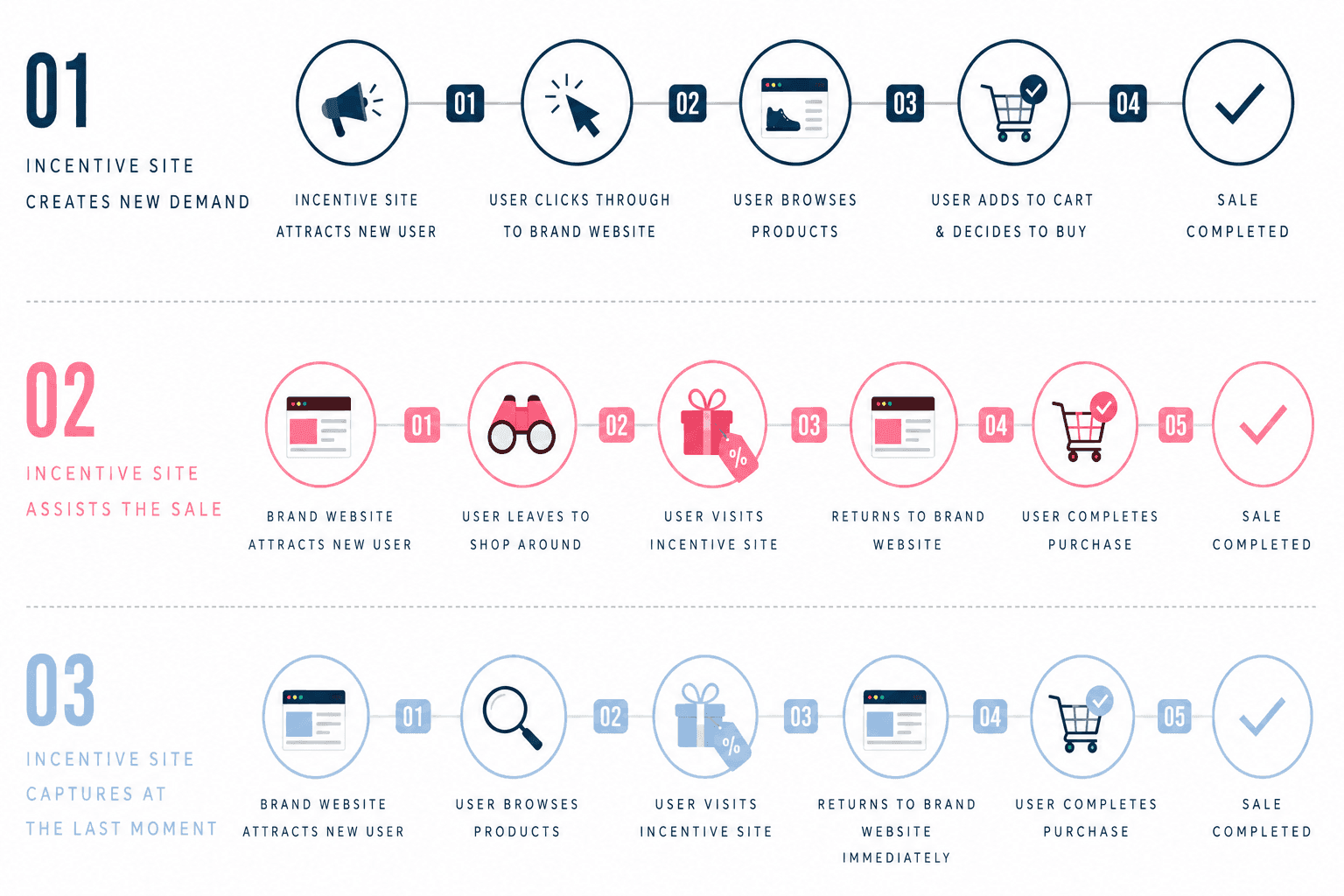
We want to look on an order by order basis and decide what role the incentive sites played in getting the sale.
For every transaction attributed to an incentive partner, there are three questions worth asking:
- Did they create the demand? Would the customer have discovered your brand without them?
- Did they assist the journey? Did they influence the customer's decision by increasing confidence, encouraging a higher basket value or persuading them to purchase sooner?
- Did they assist the sale? Or did they simply become the final touchpoint before a purchase that was already highly likely to happen?
Some orders may involve all 3, some only 1.
Weighted contribution
An affiliate partner that generates their own demand and assists the sale alone is a much higher value partner than one that only assists sales at the end of the journey. A partner that assists mid-journey is of more value than one that only helps with the sale, but of lesser value than one that also generates demand.
With this in mind, a truer reflection on partner value could be calculated by looking at total affiliate input over each of the 3 roles above (weighted by comparative value), against total sales and revenue generated. From there, the affiliate programme, commission % offered and programme terms can be optimised throughout your network.